Help your child approach mathematics with clarity, confidence and deeper understanding.
Speed, distance and time problems can seem daunting when children focus on memorising formulas. However, once they recognise the relationships between these quantities, a complicated question becomes a manageable sequence of logical steps.
At Magic Minds Education Hub, we encourage students to look beyond calculations and understand why a method works. Ratio reasoning offers an accessible way to explore these relationships while strengthening analytical thinking.
Let us examine four approaches to the same problem and discover what each can teach your child.
The Problem
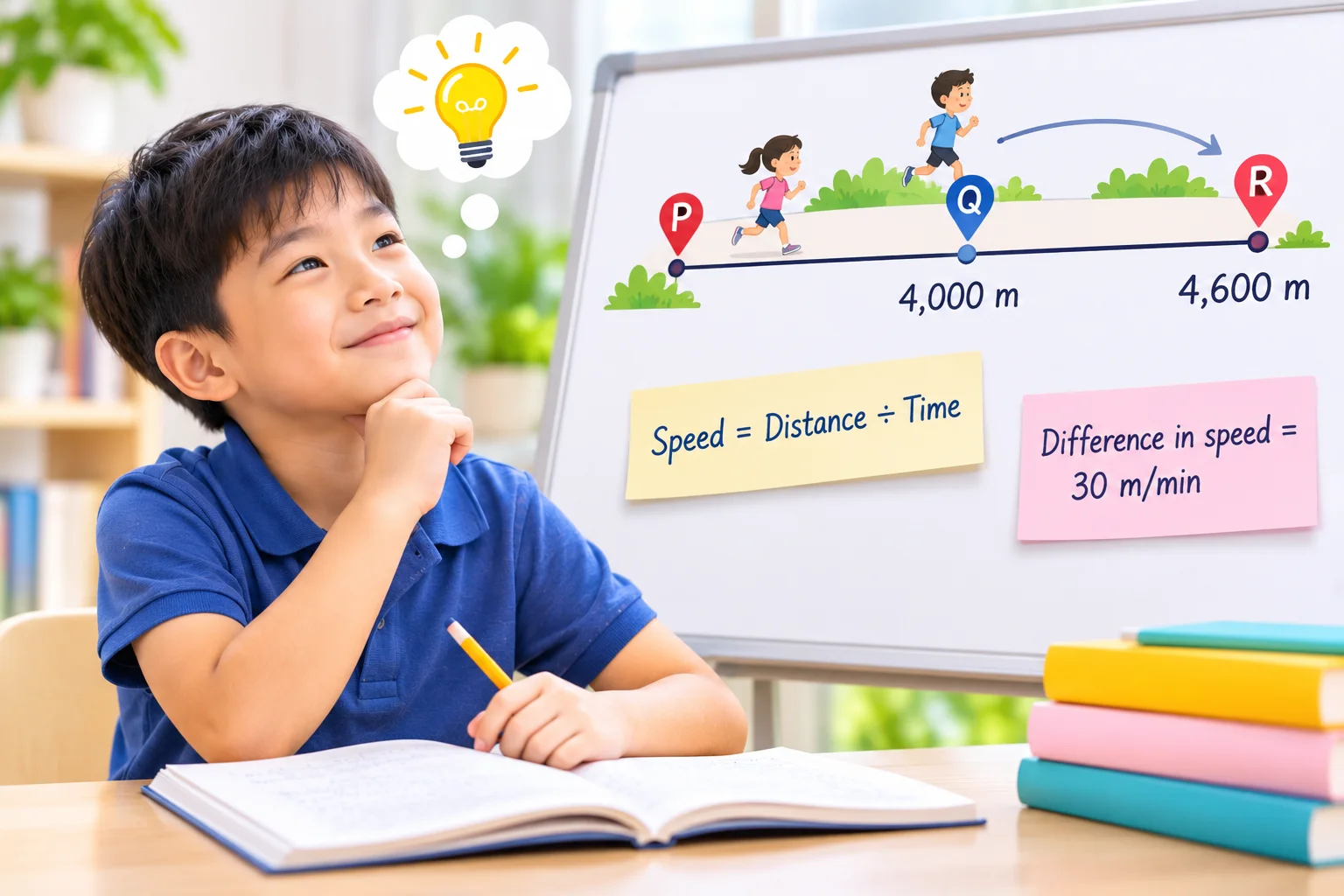
Elise and Faizal start jogging together from Point P towards Point R at constant speeds. Faizal jogs 30 m/min faster than Elise.
Point R is 4,600 m from Point P. Upon reaching R, Faizal immediately turns around and jogs back. He meets Elise at Point Q, which is 4,000 m from P.
What is Elise’s jogging speed?
First, Understand the Journey
Before choosing a method, establish how far each person travels.
Elise jogs directly from P to Q:
Elise’s distance = 4,000 m
Faizal jogs from P to R, then returns to Q:
Return distance = 4,600 − 4,000 = 600 m
Faizal’s total distance = 4,600 + 600 = 5,200 m
Therefore, Faizal travels:
5,200 − 4,000 = 1,200 m farther than Elise.
The crucial observation is that both joggers travel for the same amount of time, from their shared starting moment until they meet.
1. The Algebraic Approach: Expressing Relationships Precisely
Let Elise’s jogging speed be v m/min and the elapsed time be t minutes.
Faizal’s speed is therefore (v + 30) m/min.
Using distance = speed × time:
Elise: vt = 4,000
Faizal: (v + 30)t = 5,200
Subtracting the equations:
30t = 1,200
t = 40 minutes
Elise’s speed:
4,000 ÷ 40 = 100 m/min
Why it works: Algebra expresses the relationships systematically and precisely.
Teaching consideration: Students need to understand what the variables represent and why subtracting the equations gives the difference in distance.
2. The Distance-Difference Approach: Efficient and Logical
Faizal travels 1,200 m farther, and he covers 30 m more than Elise each minute.
Time taken:
1,200 ÷ 30 = 40 minutes
Elise’s speed:
4,000 ÷ 40 = 100 m/min
Why it works: Over the same elapsed time, the difference in distance equals the difference in speed multiplied by time.
Teaching consideration: Encourage your child to explain where the 1,200 m comes from. A short solution becomes meaningful when every calculation has a clear purpose.
3. The Ratio Approach: Making the Relationship Visible
The ratio method begins with one essential principle:
When two people travel for the same amount of time, their distance ratio equals their speed ratio.
Faizal’s distance : Elise’s distance
5,200 : 4,000 = 13 : 10
Therefore:
Faizal’s speed : Elise’s speed
13 : 10
The difference between their speeds is:
13 − 10 = 3 units
Since Faizal jogs 30 m/min faster:
3 units = 30 m/min
1 unit = 10 m/min
Elise’s speed represents 10 units:
10 × 10 = 100 m/min
Why This Method Is Useful
- Develops proportional reasoning: Students connect a familiar ratio concept to a different mathematical context.
- Makes comparison explicit: The speed difference becomes a clear difference in units.
- Supports conceptual understanding: Each calculation follows from the relationship between distance, speed and time.
- Encourages flexible thinking: Students learn to select a suitable strategy instead of relying on one memorised procedure.
Teaching consideration: The equal-time condition is essential. Students should check it before equating the distance ratio with the speed ratio.
4. The Guided Approach: Building Understanding Step by Step
For children who need additional support, begin with a labelled diagram and a sequence of focused questions:
- How far does Elise travel? From P to Q: 4,000 m.
- How far does Faizal travel before turning? From P to R: 4,600 m.
- How far does he travel after turning? From R to Q: 600 m.
- How much farther does Faizal travel altogether? 4,600 + 600 − 4,000 = 1,200 m.
- How long does it take him to cover this additional distance relative to Elise? 1,200 ÷ 30 = 40 minutes.
- What is Elise’s speed? 4,000 ÷ 40 = 100 m/min.
Why it works: Guided questions help students interpret the journey and organise their reasoning.
Teaching consideration: Gradually reduce the prompts as your child becomes more confident, allowing them to take greater ownership of the solution.
Which Method Should Your Child Use?
The most effective method is one your child can understand, explain and apply independently.
| Approach | Particularly useful for |
|---|---|
| Algebraic approach | Students comfortable representing relationships with variables |
| Distance-difference approach | Students who recognise how the extra distance accumulates |
| Ratio approach | Students confident with ratios and unit comparisons |
| Guided approach | Students who need help interpreting and organising information |
After solving the problem, invite your child to try another method. Comparing approaches can reveal connections and deepen understanding.
Check the Answer
If Elise jogs at 100 m/min, Faizal jogs at:
100 + 30 = 130 m/min
In 40 minutes:
Elise travels 100 × 40 = 4,000 m.
Faizal travels 130 × 40 = 5,200 m.
Both distances match the journey described.
Elise’s jogging speed is 100 m/min.
Build Understanding That Lasts
Mathematical confidence grows when children can explain their reasoning, recognise relationships and assess whether an answer makes sense.
The ratio method provides a clear route into this problem, while the other approaches offer valuable opportunities to strengthen understanding. Together, they show children that mathematics is a connected system of ideas.
At Magic Minds Education Hub, we encourage thoughtful problem-solving, precise explanations and confident, independent learning.
Help your child move beyond memorisation and discover the reasoning behind every solution.