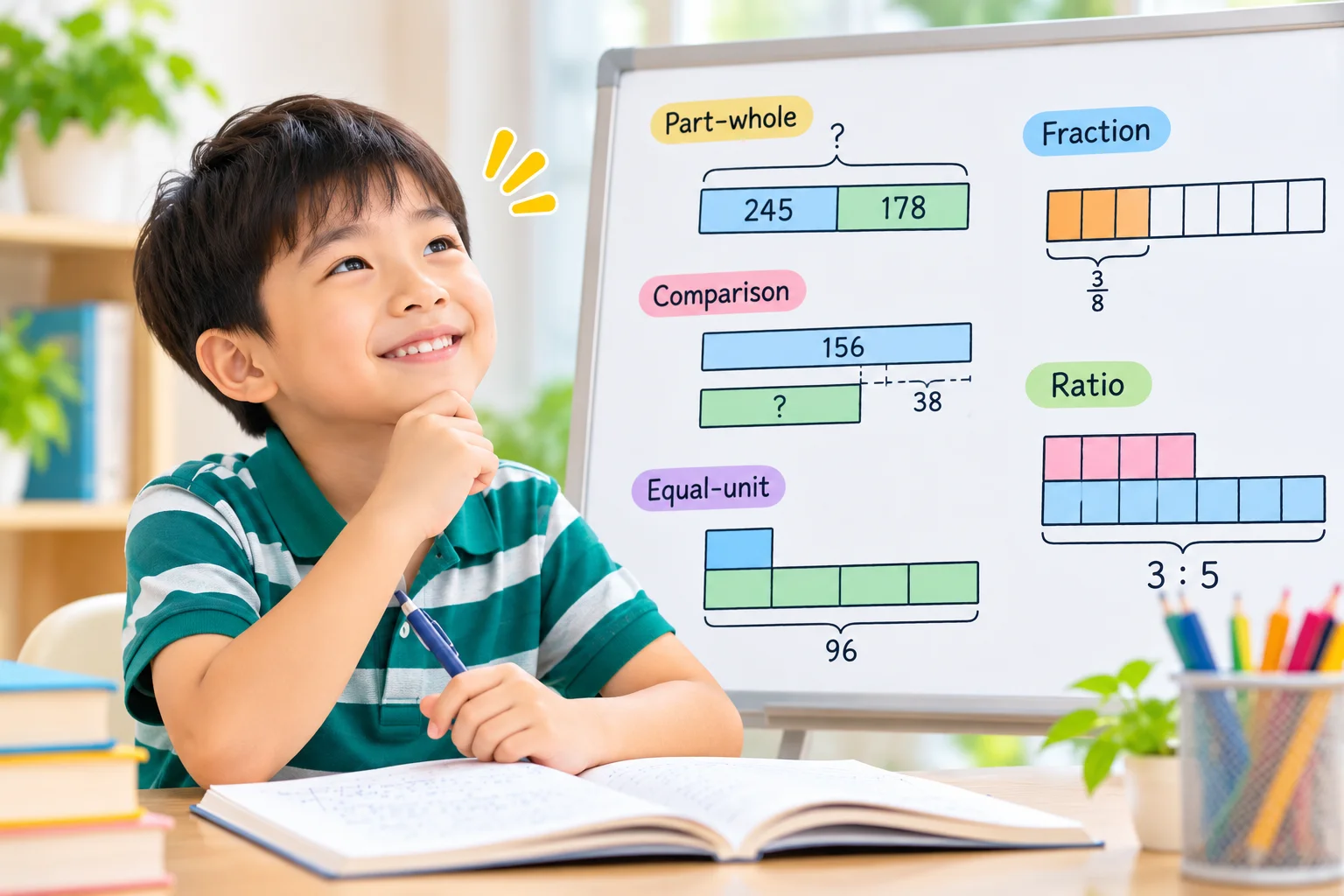
Magic Minds Education Hub
A parent’s guide to helping children visualise mathematical relationships and solve problems with confidence.
Does your child know how to calculate but struggle to decide where to begin? Word problems require children to interpret information before choosing an operation. Bar models make the relationships visible, helping students organise what they know and identify what they need to find.
A bar model uses rectangles to represent quantities. Equal sections represent equal values, while brackets and labels show totals, differences and unknown amounts. The five examples below demonstrate how a simple drawing can guide a logical solution.
1 Part–whole models
A library has 245 English books and 178 Tamil books. How many books are there altogether?

The two sections represent the parts. The bracket shows the whole we need to find.
245 + 178 = 423
There are 423 books altogether.
The key idea: the whole is the sum of its parts. If the whole and one part are known, subtraction reveals the missing part.
2 Comparison models
Aisha has 156 stickers. Ben has 38 fewer stickers than Aisha. How many stickers does Ben have?

The bars begin at the same point. The gap between their endpoints represents the difference of 38 stickers.
156 − 38 = 118
Ben has 118 stickers.
3 Equal-unit models
Mei has three times as many marbles as Ravi. They have 96 marbles altogether. How many marbles does Mei have?
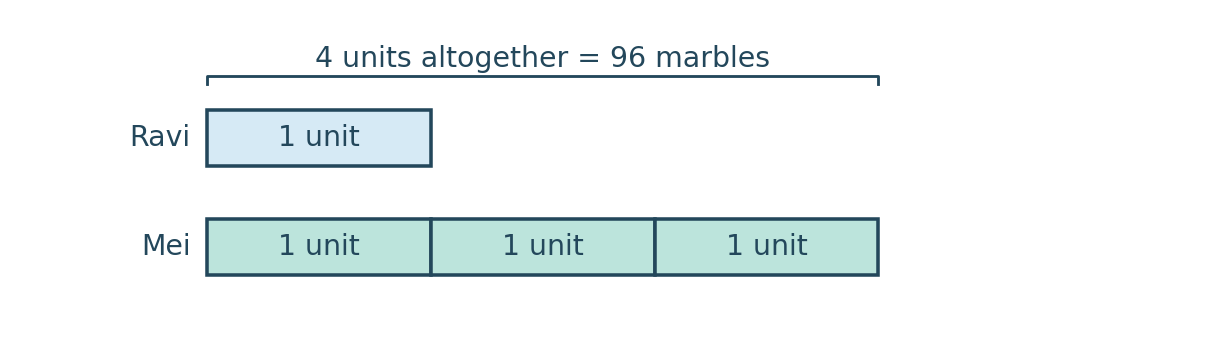
Ravi has one unit and Mei has three equal units. Their combined total is four units.
4 units = 96 → 1 unit = 96 ÷ 4 = 24
Mei’s 3 units = 24 × 3 = 72
Mei has 72 marbles.
4 Fraction models
Sara spent 3/8 of her money on a book and had $45 left. How much money did she have at first?

The whole bar has eight equal units. Three shaded units represent the money spent; the remaining five units represent $45.
5 units = $45 → 1 unit = $45 ÷ 5 = $9
Original 8 units = $9 × 8 = $72
Sara had $72 at first.
5 Ratio models
The ratio of red beads to blue beads is 3 : 5. There are 24 more blue beads than red beads. How many beads are there altogether?

The two extra units in the blue bar represent 24 beads. Once one unit is known, we can find the total of eight units.
2 units = 24 → 1 unit = 24 ÷ 2 = 12
Total 8 units = 12 × 8 = 96
There are 96 beads altogether.
Help your child explain the model
Ask “What does each section represent?” and “Where can you see the quantity we need to find?” Encourage your child to label the model before calculating, show each step clearly and check the answer against the original question.
Begin with familiar problems and gradually introduce more complex relationships. At Magic Minds Education Hub, we encourage students to develop clear explanations and independent reasoning.